


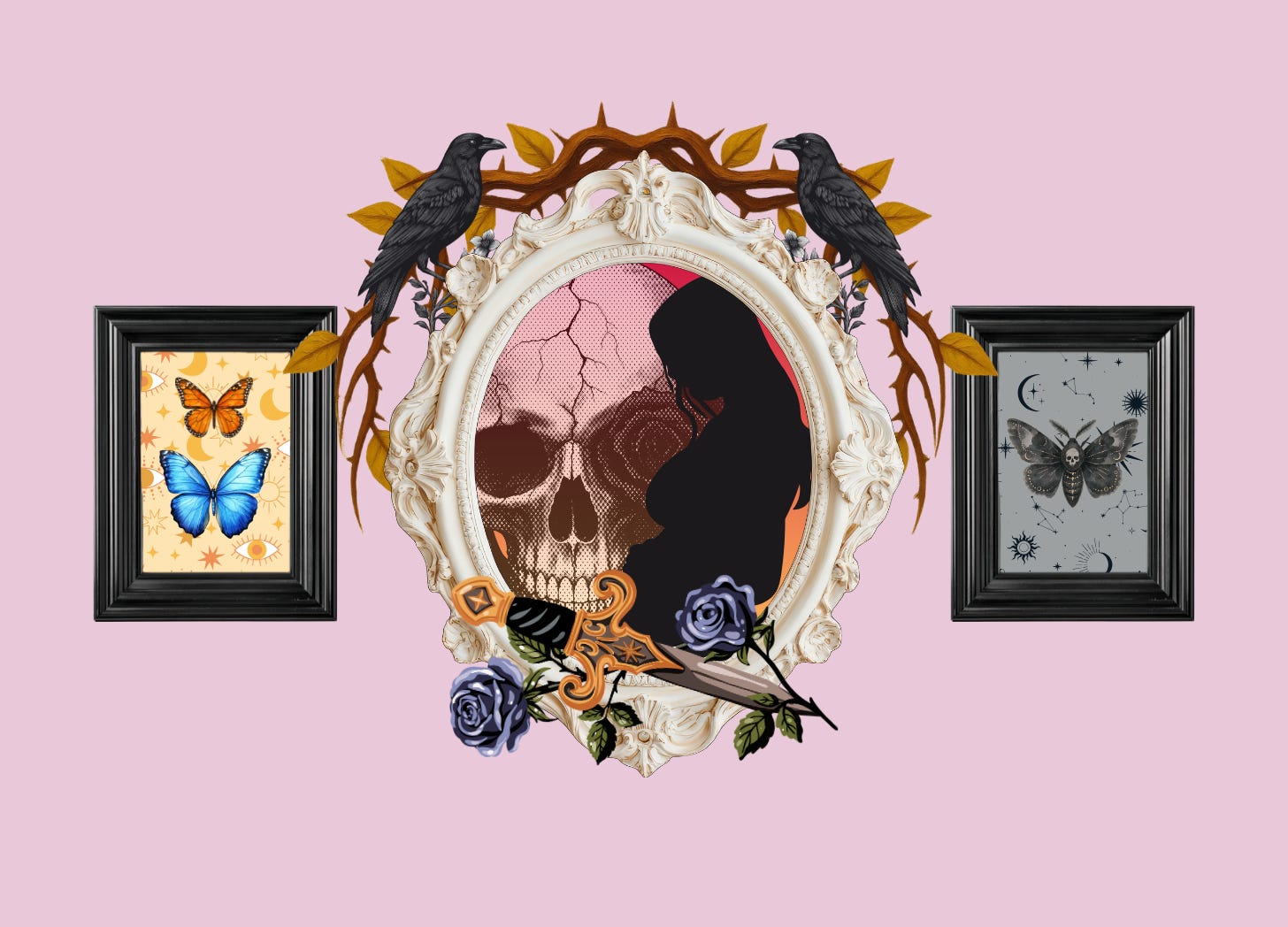
You’ve heard of vampires feeding on blood to sustain themselves, maybe even of witches stealing newborns or maiden souls for youth and power. But what about immortals who can have anything except one thing—a child? And what if one’s yearning for a child tempts her down a dark path?
“A Life for a Life” is a subversion of the immortality chaser and the selfless mother. In classic folklore and fairy tales, the childless immortal is usually a monster hoarding life at the expense of others or nature, as opposed to the mortal mother who represents pure, sacrificial love. (Never mind the fact that, historically, bad mothers in old tales were edited into stepmothers.) Here, the roles are reversed: the immortal mother becomes the monster, and the childless immortal, her grim reaper.

Things Are Not Always as They Seem
Upon first impression, you might think this tale was written to bludgeon you into accepting transgender identity. The truth is much more simple: Eva didn’t die because she was transphobic—she died because she was willing to harm Renato. There are reasonable people with reasonable questions and concerns about transgender identity, and I’ve even shared my findings and thoughts. The difference is that Eva did not see any value in Renato’s life. Her obsession with birthing a child and traditional beliefs about womanhood blinded her to the worth of another, albeit different, human being.
Renato being transgender is also relevant because he had previously “died,” hence he is “Death’s godson.” Although it isn’t explicitly stated, he had become a man in full, down to the cells in this alternate future. A trans person whose identity was not caused by mere social contagion, a trans person who transitions medically and cosmetically, undergoes a serious transformation that should not be taken lightly, a rebirth. Whereas Eva’s name means “life,” Renato’s name means “reborn.”
Don’t you think it’s ironic that Eva is the immortal who wishes for a biological child, and Renato is the one who sacrificed his womb to become an ultra-immortal man, yet ends up taking care of her son? If you read between the lines, you’ll realize that Renato had wanted children once, but he’d chosen to pursue a greater destiny that had indirectly rewarded him with a child. “Greater” in this context does not mean “superior,” but rarer and more uniquely life-changing.
Selfishness Is Ubiquitous
It is often said that some childfree people would make better parents than many parents. People who consciously choose to live without children know their limits, not just those who aren’t fond of them. The more ambivalent sort tend to understand the weight of trade-offs. They might’ve had a child or two if the economy or the planet’s changing climate was more promising. Like a priest who serves God instead of his own desires, Renato decided to serve a higher purpose, one that forced him into modest isolation where he maintains the balance between life and death.
Childfree people are normally accused of being selfish, but is selfishness always a bad thing? Selfishness can take the form of parenthood as seen in not only Eva, but real-world examples. Many people want children for reasons such as: to leave a legacy; to be loved; to be cared for when they’re old; to create the childhood they didn’t have; to keep the human species going. Yet these are all selfish reasons, even though they seem noble on the surface. That doesn’t mean they’re immoral or evil, though.
I could go on about how broader cultural factors have deepened the divide between parents and the childfree (and childless), the death of alloparenting being one, but the real question is:
What kind of mother would Eva have made?
Well, her reasons for wanting a child were boredom and to validate herself as a real woman, so that should tell you plenty. Eva had no interest in getting to know the other immortals around her. Contrary to her seemingly prosocial wish, she had grown antisocial, and all that mattered was having her wish granted without having to sacrifice her immortality in exchange. You could also interpret this as trying to avoid the inherently sacrificial nature of motherhood. A baby is not an accessory or a toy, but a future adult in the making.
In this tale, Renato is the figure of sacrifice. His choice to transition and claim ultra-immortality were selfish, but his selfishness was tailored to playing a major role in the grand scheme of things. He lives alone, though now with a child he did not birth nor bargain for, overseeing the balance of his world that cannot be cheated.
Biological Children or Biological Immortality?
The setting in “A Life for a Life” is ideal for a population that won’t reproduce itself into scarcity. This tale was primarily inspired by a common concern among life-extension skeptics. There are valid concerns to be had about an invention that would practically restructure society from the ground up, but I’m saving those for another deconstruction post and focusing on the one highlighted in this tale: overpopulation.
No matter how much death is glorified, human beings are wired to survive like any other animal. If radical life extension were available to the public tomorrow, many tunes would change and lines to be approved for the youth serum would form. Without proper oversight, there would almost certainly be a population boom, and Earth is already dealing with pollution and voracious consumers of factory-farmed meat, long-distance traveling, and mass-produced junk.
The true irony in such a world, however, lies in the idea that people choosing to be biological parents would also want immortality, considering how often we hear about the “natural order” and how “death gives life meaning.” In a world where you could have either biological kids or biological immortality, people choosing the former shouldn’t be lamenting their inevitable fate; rather, they should be embracing their finite amount of time as they do now, dedicating it to raising the next generation of humans who will repeat the cycle, eventually choosing one option or the other for themselves. If there’s any group that deserves to glorify death, it’s parents. (That is not sarcasm, by the way.)
I would hope that, if/when radical life extension is achieved, governments have figured out how to properly implement it, and in ways that go beyond the strict binary I introduced. With the ongoing decline in birth rates, and the continuous march of medical science, I imagine this tale will maintain relevance for a while.
But, even if by some miracle a sweeping number of women are compelled to opt in to motherhood, the moral lesson remains: learning to value the lives of currently existing people over hypothetical people, and seeing the worth in others who take different life paths, which add more color to the tapestry of human existence.