


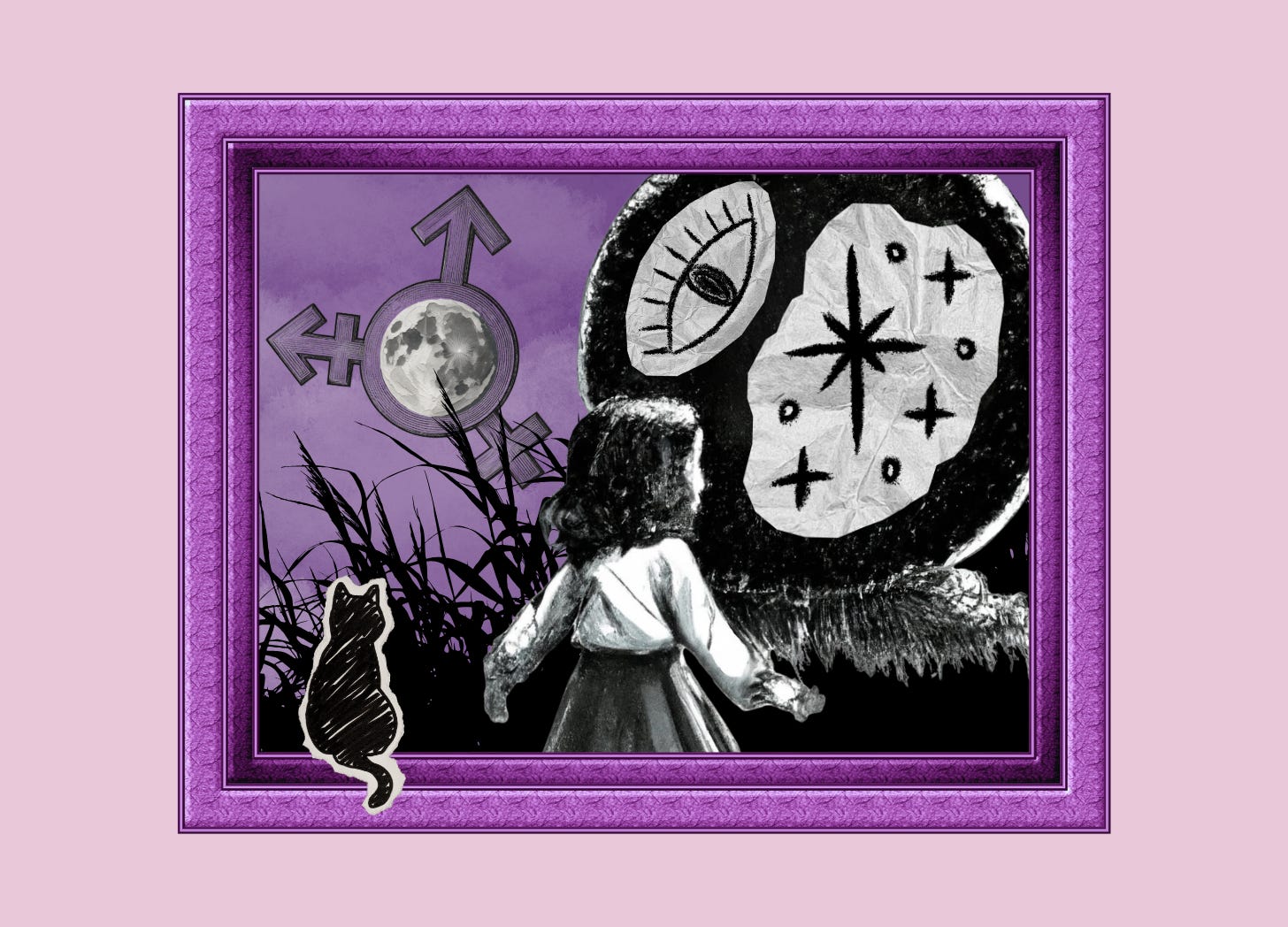
I used to think I might’ve been trans. Growing up, I looked and acted like a boy most of the time. Having a bowl cut, thin lips, and angry mountain-shaped eyebrows did not help. (I get those cursed fuckers waxed and fill them in now, and what a difference.) I identified with Ralphie from the Magic School Bus and wanted everyone to call me Ralphie. Unsurprisingly, nobody did.
If I had access to hormones and sex reassignment surgery at the time (let’s pretend that’s totally legal for minors for a moment), and I’d gone through with transitioning, I would’ve turned out even more messed up than I already was. My problem wasn’t that I was actually a boy in a girl’s body. It was that I exhibited traits that society deemed boyish, personality traits influenced by my physical traits. And so I wanted to be a boy because girls were supposed to be pretty and feminine.
I still battled with gender dysphoria as a teenager, but this time I was fat, which worsened those feelings. A lot of my girl peers looked and acted more feminine than me. They knew how to dress, do their hair, wear makeup, and stay skinny. They did not have ridiculously thick hair or pencil lips or angry mountain eyebrows. Needless to say, I do not miss my school years.
Through the mid-2010s, I identified as a sort of nonbinary, but only online. I had a gender-neutral name and wanted my friends to use they/them pronouns for me. They seemed to forget, though, and I was too awkward to remind them. Or maybe I wasn’t truly nonbinary after all. What does nonbinary even mean, really? What about man and woman? Or genderfluid? What the hell is galaxygender?
When people (mostly online) started distinguishing between gender and sex, I thought it made sense. Gender is social and sex is biological. But then people started denying biology altogether, claiming sex and gender were interchangeable because the biology of sex was more complicated than what high school taught.
I know how annoying “assigned male/female at birth” might sound to the gender-critical, but babies really are assigned a sex at birth according to which set of genitals their bodies have. In reality, sex is determined by a combination of:
Chromosomes
Gonads
Hormones
Internal reproductive anatomy
External genitalia
Intersex people are born with naturally occurring variations of the aforementioned that don’t fit the standard definitions of male or female. Historically, the strict binary view led to doctors performing cosmetic, non-consensual surgeries on intersex infants to force their bodies into one of the two boxes. Yes, intersex is technically a deviation from the norm, but that doesn’t mean intersex people have to identify as “male” or “female” just to make you feel more comfortable.
That said, reproduction involves two gametes. Not three, not a thousand. Two. Males produce sperm and females produce eggs. Humans are also a sexually dimorphic species. Male and female bodies have differences in waist-to-hip ratio, body fat, muscle mass, bone density, etc. If you enjoy being a hyper-constructivist, sure, biology is complicated. But if you step back and look at the bigger picture, nature/evolution did “intend” a design. It’s these differences between most human bodies, along with other factors (geography, technology, and resource scarcity), that influence culture, which consequently gives rise to gender roles.
The Material Origins of Masculine and Feminine
In many hunter-gatherer societies (like the !Kung of the Kalahari or the Hadza of Tanzania), gender roles exist, but aren’t rigid. This isn’t because biology is ignored, but because the immediate environment made biology a baseline for collaboration instead of exploitation. Since these groups rely on immediate, wild food sources, everyone’s daily contribution is visible and vital. Although men do most of the hunting and women do most of the foraging, they aren’t inherently locked into their roles.
Foraging allowed women to carry nursing infants while gathering. The physical constraints of lactation influenced which tasks were most efficient without relegating women to a lower social status. In tropical or moderate environments, gathered plant food provides up to 60–80% of daily calories. Because women were the primary breadwinners, they held massive social and political bargaining power.
Survival in freezing, high-latitude environments, however, demanded extreme adaptability. Despite what recent studies highlight about women’s participation in hunting, hunter-gatherer experts emphasize that long-distance, high-risk big game hunting was mostly done by men. This allowed women to balance childcare with the equally critical, labor-intensive tasks of processing hides and manufacturing complex gear for the cold weather.
So, how did the West settle on its specific, patriarchal brand of gender roles?
For starters, the breadwinner-homemaker dynamic is actually a recent historical invention. Rather than being some ancient, universal human truth, Western gender roles were forged by a specific sequence of economic revolutions, ideological movements, and mid-20th-century media culture.
Prior to the Industrial Revolution, the household operated as a single economic unit where men and women worked side-by-side to ensure basic survival. When industrialization physically pulled work out of the home and into distant factories, it created a structural split: cash wages fell to men and unpaid domestic care fell to women, resulting in the middle-class “separate spheres” ideology, framing the public world as male and the private sanctuary as female.
Class signaling and post-war economics eventually turned this economic split into a rigid aesthetic. The 19th-century elite used corsets, pale skin, and physical fragility to prove a woman couldn’t perform manual labor. Meanwhile, urban panics about men becoming “soft” created a rugged, outdoorsy ideal of masculinity. This dynamic reached its peak in the post-WWII suburban boom, where single-income prosperity and mass media propaganda codified the rough-and-tough, male breadwinner and the child-raising, female homemaker into an “ideal” family template.
To be clear, I have nothing against a man and woman wanting to live a “traditional” Western lifestyle together, as long as they educate themselves and accept that such a lifestyle isn’t suited for everyone, potentially including their own kids who will grow up to make their own decisions regardless of how they were raised. Knowing the historical truth about the origins of things shouldn’t invalidate the meaning they could hold for you. There is no need to justify your desire to wear prairie dresses or cook meals for your husband, and if someone tries to give you a stern “feminist” talking-to, pull up your pantaloons, ignore/block the nuisance, and keep living your best tradlife.
How Gendered Feelings Evolved into Social Categories
Human biology plays a role in forming society’s perception of masculine and feminine. In the West, this has evolved into accentuating the two, with dresses, makeup, and emotions being associated with women, and beards, muscles, and stoicism being associated with men. Seeing the puppet strings doesn’t render these categories entirely fake or illusionary, but it does reveal how trans people (including enbies) are a natural, inevitable pushback against our culture’s habit of shoving everybody into one of two uncompromising boxes.
People who identify as trans or nonbinary might’ve been fewer today—so few that it’d be like encountering a unicorn—if society hadn’t been as obsessed with gender. People likely wouldn’t have bothered making a distinction between gender and sex, let alone coming up with xenogenders.
On the other side of the issue, gender roles, again, are not totally arbitrary; they are cultural superstructures built on top of biological reality. Human beings are hardwired to categorize, signal, and organize around biological sex, which is why we have people creating their own categories—doing so allows those who can’t meet gendered expectations to navigate a world that is obsessed with gender.
None of this should be surprising, not even the concept of xenogenders. Gender-nonconforming people and multi-gender systems have existed across the human spectrum for millennia, but the specific distinction between gender and sex is, as I mentioned earlier, another recent invention.
The conceptual split between the two began in the 1950s. Psychologist John Money and psychiatrist Robert Stoller were studying intersex individuals and transsexual patients, and they needed a way to describe a patient’s biological traits (anatomy and chromosomes) versus their psychological and social role in society. Stoller explicitly defined sex as biological and gender as psychological/social. In the 1970s, second-wave feminists popularized this distinction to prove that biological anatomy did not dictate a woman’s societal destiny, and by the 1990s, postmodern theorists like Judith Butler expanded this idea further, arguing that both gender and our perception of biological sex are fluid, socially constructed performances rather than fixed binaries.
Finally, in the 2010s, micro-communities on Tumblr.com that consisted of predominately young people developed “xenogenders,” using non-traditional metaphors, moods, and aesthetics to describe their internal experiences that didn’t fall into traditional human categories. Ultimately, the separation of sex and gender shifted from a practical medical distinction into a tool for social liberation, then into a fluid, highly personalized framework for digital identity creation.
If something like xenogenders is still weird to you, I get it. I sympathize. But hopefully you understand this isn’t some evil agenda to turn people into corrupt, godless heathens. It’s humans being messy and complicated as humans are.
Trans Identity Is Here to Stay (but Some Concerns Are Valid)
I might get heat for this, but there are some valid concerns to be had, and they’re not limited to public bathrooms or sports.
For the most part, I don’t support giving hormones or surgeries to minors. Kids should be allowed to transition socially and experiment with gender, but such medical decisions are for consenting adults. However, there are some rare exceptions like Ella Grant who transitioned young and never regretted it; in fact, it saved her life. In cases where gender dysphoria is severe, long-standing, and completely resistant to non-invasive psychological support, rigid age caps can sometimes inflict irreparable harm.
The challenge lies in diagnostic rigor: distinguishing between extreme, lifelong dysphoria and the temporary, trauma-induced, or socially driven distress that affects many teenagers today. A compassionate framework reserves early medical care for those exceptionally rare cases where the alternative is psychological collapse, and it ensures the vast majority of youth are protected by time and careful exploration as well.
I don’t think exclusive spaces are inherently problematic. The reality is that cis people and trans people have some fundamentally different experiences. For biological women especially, single-sex spaces—namely domestic violence shelters, rape crisis centers, prisons, and sports categories—were established to address specific physical realities.
In trauma settings, the presence of male secondary sex traits can trigger severe psychological distress in survivors of male violence, regardless of the trans individual’s character or intent. I don’t think public bathrooms are a big deal because you shouldn’t be seeing anyone’s genitals in a woman’s bathroom. People use the stalls. Banning trans women from entering women’s bathrooms doesn’t ensure cis women’s safety. Predators will be predators regardless of their gender identity (and most of those predators are cis men, not trans women).
In sports, single-sex categories exist to preserve fair competition between biological baselines. Long-term hormone therapy significantly reduces muscle mass and red blood cell counts in trans women, but it can’t rewrite the skeletal leverage, shoulder width, or lung volume gained during male puberty. While some advocates point to emerging studies suggesting trans athletes face unique physical trade-offs, the broader sports science data shows that male-puberty advantages are rarely fully erased. Until sports science can cleanly isolate those variables, directing athletic categories based on biological sex, while treating the traditional male division as an Open Category, is the fairest way to protect female athletics without demonizing trans athletes.
What about trans men in sports, you ask? Well, trans men face immense personal hurdles and physiological uphill battles when competing in male divisions, as exogenous testosterone cannot manufacture the larger skeletal frames or lung volumes built during male puberty. Since they don’t have puberty-given advantages that create friction with cis men, their participation in the male division is almost universally permitted as an Open Category.
Sexual assault and unwanted sexualization can also push people to transition. Therapy for a trans person whose identity was the result of either might relieve them of the desire to, but transitioning might also be the best way to heal their trauma. There are some things you can’t “fix” with enough therapy and medication, and no, being transgender is not comparable to having body integrity dysphoria, a condition that makes one feel they need a limb removed. Reassignment surgeries are meant to modify the appearance of the body, not disable it. Trying to ban them would be like trying to ban rhinoplasties and other cosmetic surgeries.
Of course, this raises broader questions about how modern culture approaches body modification as a whole. Hyper-consumerism goes hand-in-hand with predatory media and beauty industries that profit off insecurities, which, as you must know, is nothing new. Society increasingly treats physical alteration as a quick fix for psychological discomfort. All surgeries carry risks, but psychological evaluation should be a prerequisite for some cosmetic surgeries in particular.
This isn’t me saying you shouldn’t get a nose job or breast implants, whether you’re cis or trans, but requiring adults to engage in therapy before undergoing significant, irreversible procedures ensures that genuine, persistent physical distress is treated before attempting to surgically cure, say, unaddressed trauma or low self-esteem caused by societal beauty trends. Detransitioning can entail deep regret, medical trauma, severe re-emergent gender dysphoria, endocrine crises, healthcare barriers, and community loss. Medical transitioning is not a decision to be made on a whim.
Transgender identity is also not a pipeline to otherkin (identifying as something that isn’t human). Transgender identity deals entirely with human sexual dimorphism. Transitioning involves altering secondary sex characteristics within the existing framework of human physiology. Claiming to be a non-human animal or a mythical creature is an entirely different phenomenon that lacks any biological, anatomical, or medical precedent. Equating adult gender transition to “animal surgery” is nothing more than a cheap culture-war caricature, designed to ridicule real human suffering and derail serious conversation. Let’s not lower ourselves to false equivalences, okay?
Conclusion: Reality Sucks, but We Can’t Change It (Yet)
Human bodies have real constraints and baseline physiological trajectories that language games, unfortunately, cannot hand-wave away. Pretending none of that exists creates problems in healthcare, trauma spaces, and sports.
Ideological purity tests help no one. We don't have to choose between hyper-constructivist absurdities and culture-war bigotry. Respecting preferred pronouns is respecting another human being’s autonomy—it costs you nothing, and it doesn’t have to lead to denying biological reality altogether. Nuance is your friend.
Today, we have cross-sex hormones and reconstructive surgeries, but science will keep progressing. Future advances in genetic tools, tissue engineering, and biotechnology could eventually reach the point where we can alter our biology at a cellular level. Until that future arrives, though, we have to deal with the parts that suck about living in the physical reality to which we’re all bound.