


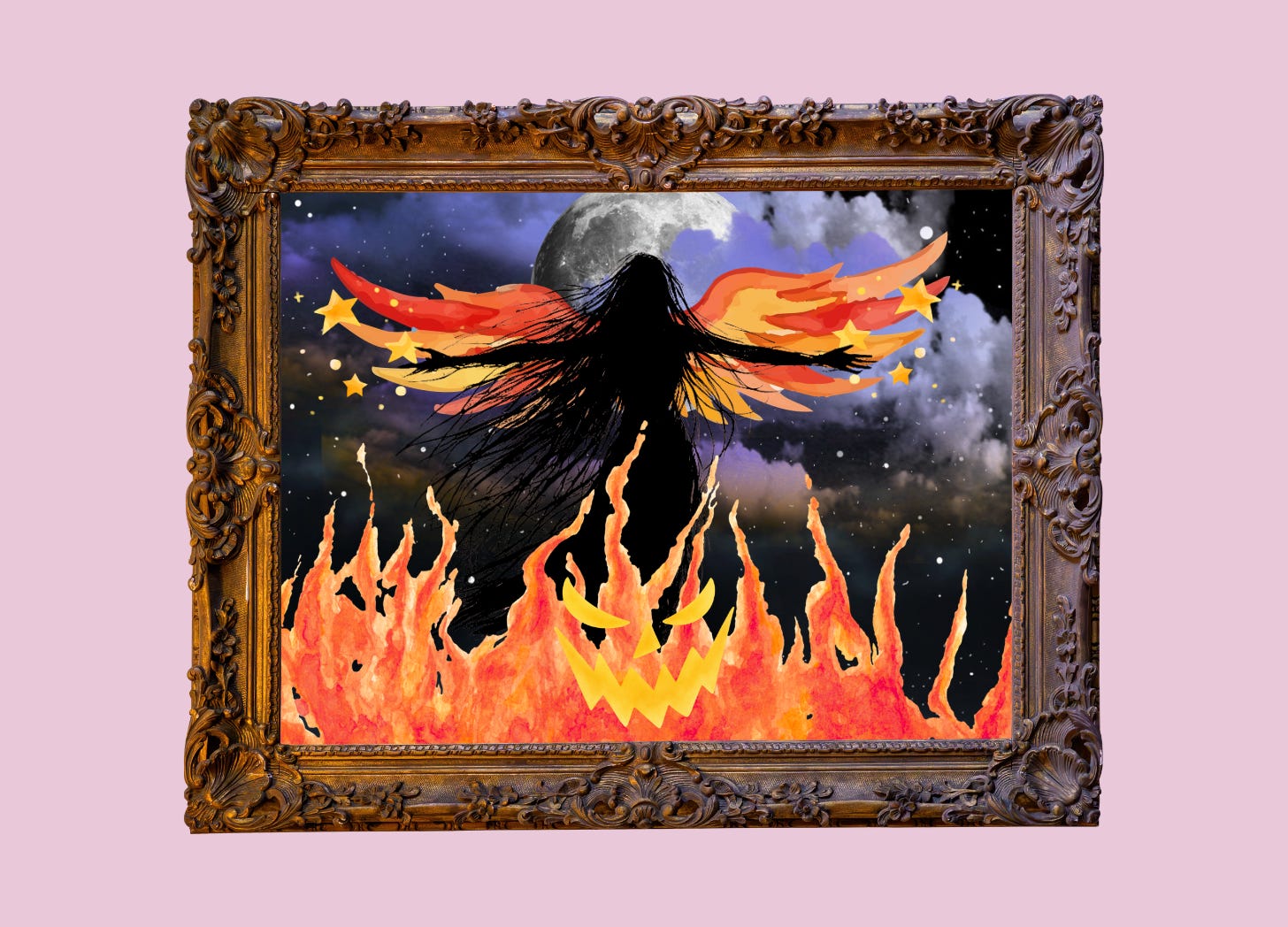
“Witch Wings” was my first fairy tale, and the only one besides “Pen Dragons” that was originally intended to be a novel.
This probably isn’t surprising, but around 2017 I was calling myself a witch. Witchcraft was making a comeback among Tumblr users especially, many of whom were young women that dreamed of destroying the patriarchy and hexing Trump. No, really. There was a mass movement to hex Trump. No, I did not join.
What I did join was “Witchblr,” though I barely engaged with others and mostly reblogged posts in silence. I watched as a schism formed between two groups of witches: modern and traditional. The modern witches liked glitter and emojis and crafting “like to charge, reblog to cast” spells. The traditional witches, the boomers of witchcraft, looked at these youngins with contempt. Kids these days, disrespecting the real craft and its historical ties to the Devil (also known as the Man in Black) himself!
Indeed, at the time, on that particular website, traditional witches claimed to be practicing true witchcraft, not the fluffy-bunny stuff in Charmed or the Wiccan religion. They claimed that a witch could only access magic through spirit work, and the Devil was a central figure. Apparently, the witch trials were justified. (Note the sarcasm in my text.)
Personally, I’ve had a spell or two yield better results than expected, and I didn’t have to bargain with any spirit. Then again, I could’ve been lucky. I didn’t practice much. The incentive wasn’t really there, as I wasn’t financially struggling or seeking a relationship like other witches were. I was more interested in understanding how magic and witchcraft even worked, and why spirits fueled by human imagination—books, movies, TV shows, etc—couldn’t be just as real as the fabled gods of old. (Spoiler alert: they can, it’s called “pop culture paganism.”)
Traditional witches seemed to love The Witch (2015) and Salem (TV 2014). I remember one of them expressing a wistful longing to fly freely across the sky with a coven, just like “witches in the old days.” I guess you can’t do that now because of planes and smartphones.
I also remember one traditional witch who hated the turn that Salem had taken. I assume it was the cliché reveal that the Devil wasn’t a true liberator after all. But I have to agree with the unsurprising plot twist.
Quite a startling number of people, not just traditional witches, viewed Thomasin’s embrace of witchcraft in The Witch as an allegory for breaking the chains of puritanism. I’m not sure how any feminist could watch this movie and think a girl was empowered instead of manipulated. The Devil did not approach her in the beginning with an offer of freedom and butter. He had his witches torment the family and turn everyone against her until she couldn’t say no.
Between The Witch and Salem, I was inspired to write a story about a witch who reclaimed her power and freedom from the Devil, and without turning to the Christian god, or any god or goddess, for that matter. That story perished halfway through as a novel and later rose from the ashes as a fairy tale.

Transcending Dualities and False Dichotomies
Why is it always God and the Devil? Heaven and Hell? Good and Evil? Where’s the third path, the middle ground, the gray? We humans love our neat little color-coded boxes, don’t we? Chilling Adventures of Sabrina was initially bold enough to tackle the idea of a third path. It failed miserably, but I wasn’t shocked.
There’s an elephant in the rooms of most religions: life is a horror show. Whether you believe in a divine plan or not, it’s unfeeling to deny the insane amounts of suffering and death that happen here. Things were certainly far worse the further back in history you look: slavery, famine, deadly diseases, women dying in childbirth, children dying before reaching adulthood, living in squalor and working to the bone from dawn until dusk. The world we inhabit today (specifically for those of us living in developed countries) is a vast improvement overall. Our ancestors would’ve killed to have the freedoms and luxuries that we have.
But that was (and still is) the function of religions like Christianity—to turn chaos into order; to make all the blood, sweat, and tears seem worth it; to keep people in line so that you, too, may enter paradise upon death. This isn’t a bad thing, per se. It’s the natural result of a species intelligent enough to comprehend its own mortality. Rigid rules and morals were meant to ensure the survival of a community. Life was much harder without communal effort to keep everyone fed, clothed, and safe. Fairy tales warned against disobedience and curiosity for a reason.
Now, though, science has shed light on many natural phenomena—at least in regards to the “how,” not so much the “why.” Faith continues to answer the latter, and I imagine it always will. For the record, I’m not an anti-theist who wants to see the end of religion. I do, however, want to see the end of anti-curiosity.
Curiosity and caution are not mutually exclusive; you can exercise both at the same time. Elspeth, the protagonist in “Witch Wings,” was more curious than cautious, but she was also desperate. She was feeling as confined as she had when she lived under religious rule. The things she did with her coven weren’t enough to satiate her hunger for something more.
The Search for Real Wings
Like God who told Adam and Eve not to eat the forbidden fruit, the Devil in “Witch Wings” tells Elspeth not to venture beyond the villages, or he will take back the gifts he’s given her and make her mortal (again). Instead of getting kicked out of the garden, Elspeth chooses to leave it and follow her curiosity. What she finds are ruins of a dead civilization, the old world that the Lord had cast into darkness. This was a nod to the novel’s plot: many moons ago, a massive EMP wave hit and the world descended into chaos. Only a scattering of communities remained, one of which was the village of Celestia, spared by a prophecy that had long prepared its villagers.
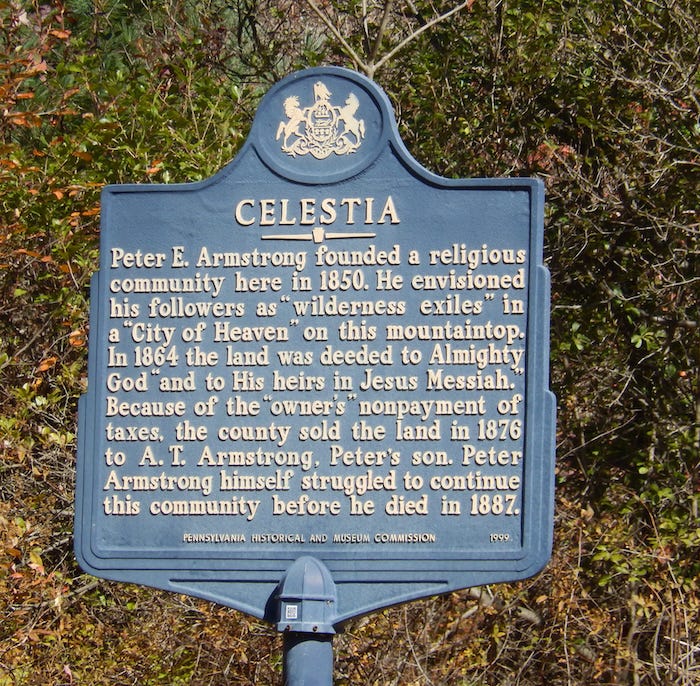
Yep, once upon a time Celestia existed. It was more of a commune than a village, founded in 1850 by Peter E. Armstrong, where followers could gather and await the second coming of Christ. Due to property tax disputes, fading faith, and Armstrong’s death in 1887, it was eventually abandoned.
Celestia was obviously the perfect starting point in my apocalyptic fantasy novel. The EMP wave, however, had not necessarily been an act of God, but an act of… aliens.
You can see how this novel kind of went off the rails. I have a history of abandoned projects like that. (Can you tell I loved the genre-blending chaos that was American Horror Story: Asylum?)
There are no aliens in “Witch Wings,” though. Or maybe there are. You could interpret the old, ruined world as having been caused by either aliens or God. Both represent the nail in the coffin of a belief system that was already fragile, such as Elspeth’s faith. Neither reached out to save her, and the Devil only tried to control her.
Transactional Power vs. Individual Power
Gods, spirits, and aliens (whether or not you believe) seem to be human magnets. Many humans just can’t help gravitating toward something greater than themselves. I consider myself a religious pluralist. Although some are steeped in uglier histories than others, I believe all religions have value and are right for the people who are naturally called to them. Religion has roots in inspiration, and inspiration is the fire that forges art.
But not all humans need religion. The most empirical-minded of us can live happy, fulfilled lives and create beautiful or thought-provoking art. Religious extremists will deny this, just as super-serious traditional witches will deny that magic can be done without spirit work. Modern witches might incorporate animism, but animism is essential to traditional witchcraft. Animism is the belief that everything contains a spirit. By that logic, humans are also spirits, and thus humans can arguably create their own magic without the assistance of external forces. You could argue that the magic of nature spirits runs deeper and offers more or other exclusive sorts of power, but that’s different from saying humans are inherently magic-less.
I recall traditional witches on Tumblr speaking of witch initiation as a long, intense process. The more you’re willing to sacrifice, the more the spirits will be open to working with you. Give the spirits what they want, and the spirits will give you what you want. It’s basically as transactional as you can get in the witchy world. Call me a “fluffy bunny” for preferring more friendly and intimate spiritual connections with fictional characters, I guess.
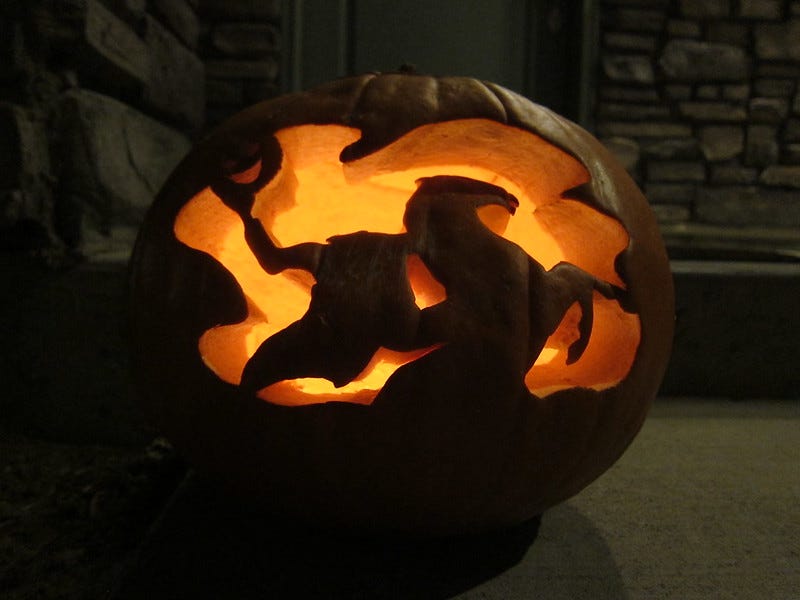
If you ask me, humanity’s true magic or power does lie in imagination, and this is the message behind “Witch Wings.” Elspeth has the choice to leave Dayana and return to the villages, where the Devil will surely be waiting for her. Instead, she takes a chance with Headless Jack. In the novel, Headless Jack was the result of two folk tales—the Headless Horseman and Stingy Jack—meeting and merging into one. In the fairy tale, he represents an alternative that values curiosity and creativity. He asks for nothing but works of the inspired mind in return.
If God exists, maybe that’s what He/She/They/It is—an all-encompassing source of not just love, but love of creation. Why else would the universe have been created?