


Despite having been raised Catholic, I was always pretty “meh” about God. Maybe it’s because my parents weren’t too serious about it. I don’t remember attending church every Sunday, but I did attend catechism school once a week and made my communion. I didn’t make it to my confirmation because I grew dissatisfied and started questioning the doctrine. The priest did not approve and arranged to have me kicked out. My mom (surprisingly) blamed him instead of me, and my dad couldn’t have cared less.
Left to my own curious devices, I grew up burning through different beliefs, never satisfied with any. Westerners go on about karma and Earth school and returning to “Source,” but I continued to question. I questioned the ethics of reincarnation and dug around more and learned about the reincarnation soul trap theory. At that point, I was veering toward maltheism, the belief that God exists but is a malevolent entity who delights in suffering. It’s similar to Gnosticism, except Gnostics believe the root of all suffering traces back to the Demiurge, a false God who created the physical universe. Whether the Demiurge is a sadistic puppeteer or is oblivious to the micro-effects of its macro-actions is debatable, but it’s a debate I’ve long moved on from.
Eventually, I accepted that I simply wouldn’t find a fitting belief system. Having felt like an alien for as long as I can remember, I would always be on the outside looking in. Although I’ve matured and learned that I am in fact more human than I thought, in some ways I still am on the outside looking in and always will be, which seems oddly reflective of the religion I’ve finally settled on.
By my early 30s, I discovered YouTuber Jessica Kellgren-Fozard, a happily married lesbian Quaker who discussed her religion, and realized Quakerism was for me. No, I have not been asked if I eat Quaker Oats (I do—not because I’m a Quaker, though), but I have been asked if I’m Amish. I don’t even dress remotely Amish.
Founded by George Fox in 17th-century England, Quakerism feels as though it has one foot in faith and the other in secular humanism. There’s no creed other than “that of God in everyone,” which means no one person has exclusive access to communing with the divine; everyone is capable of tapping into their inner “light.” There are no priests, nuns, bishops, deacons. No incense or hymns or other ritualistic frills. A Friends meeting is one of silence and deep contemplation, taking place in a simple, modest building called a meeting house.
There’s a meeting house not far from me, though you aren’t required to join one. For a while I preferred keeping to my own inner journey, especially since I was so uncertain about God. Is God an independent entity? Is God a fancy word for the universe? Is God merely observing us, never to intervene in human affairs? Could God have been fickle and left a trail of abandoned projects behind, Earth included? Is God just our imaginary Sky Daddy to help us tolerate life on a floating rock in an endless void?
I still don’t know the answer, but history and human nature shed quite a bit of light.
God in the Flesh Machine
Ludwig Feuerbach was a German philosopher and anthropologist who viewed God not as an independent, supernatural entity, but as a psychological projection of humanity and its greatest wish for an unending source of love, compassion, wisdom, order, and immortal life. In many religions, even those that appear at odds from different continents, you can find similarities:
The Christian believes in one God who will open the pearly gates to them through acceptance of Christ and a life of repentance.
The Wiccan believes in a God and Goddess who embody the forces of nature and mirror seasonal changes, with the Summerland serving as a temporary afterlife between incarnations.
The Buddhist seeks detachment out of enlightenment to transcend Samsara and achieve Nirvana.
The Daoist seeks peace with existence in all its forms by aligning internal energies (Qi) with the natural flow of the Dao.
The techno-optimist dreams of a superintelligence that will usher humanity into a glorious transhumanist future.
The radical communist looks forward to the Revolution that will break the chains of capitalism, lifting everyone (who managed to survive the apocalyptic aftermath, at least) into a post-scarcity utopia where nobody has to work.
All these beliefs are different. Yet, under all their layers, they share the same core: the very human desire for a higher order that makes sense of the universe’s chaos, and to rise above this mortal coil and enter some version of heaven.
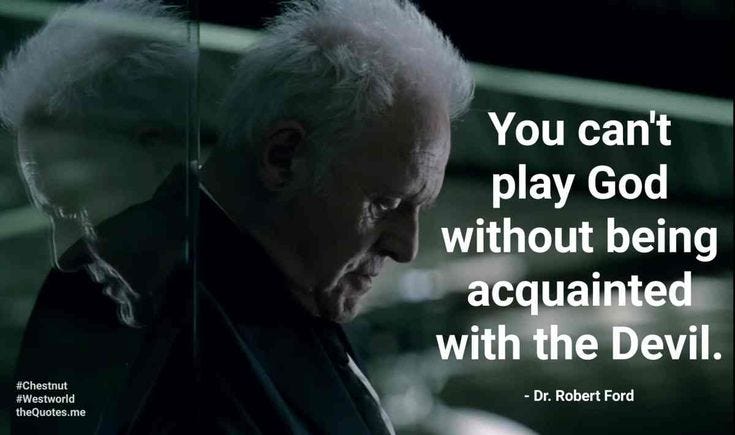
Dr. Robert Ford from Westworld (2016) said it best: “You can’t play God without being acquainted with the Devil.” Creation, consciousness, and power are inherently tied to suffering, knowledge of darkness, and destructive potential. You can’t have the light of elevated awareness without inheriting the shadow it casts.
The most blasphemous fact about us Quakers is that we believe in ongoing revelation. This makes the Bible, to us, not the final Word of God. Some of us don’t believe it’s the actual Word of God at all, but the Word of Man that might’ve been inspired by God at the time, and Man is fallible, a limited translator. This doesn’t mean the Bible is a useless historical artifact. The stories can still hold relevance and lessons. I dare say the most timeless and universal story is Genesis.
In my humble opinion, Genesis isn’t a story about two people who actually lived in a paradisiacal realm once, but an existential grappling with the emergence of consciousness.
In the Garden of Eden, time didn’t matter. There was no suffering or death. Adam and Eve weren’t even aware they were nude. Life was idyllic. In reality, animals experience pain, lust, hunger, and exhaustion, but they do not conceive of them. Animals simply eat when they can, sleep when they can, and mate when they can or when the weather encourages it. To an animal, it hasn’t left Eden; Eden is all it knows.
God banishing Adam and Eve wasn’t necessarily punishment for disobedience. It is the logical conclusion to developing hyper-awareness of one’s place, environment, and mortality. To know “good,” you must know “evil.” You can’t conceive of beauty, transcendence, or divine order without becoming hyper-aware of decay, cruelty, and oblivion. From the Tree of Knowledge, humans created art and science and civilization, but the price of admission was a lethal dose of existential dread, overthinking, and the capacity for malice.
“Man has lost his citizenship in the universe; he has eaten from the Tree of Knowledge and has been banished from paradise. He is powerful in his world, but he curses his power because he has bought it with his soul’s harmony.”
— Peter Wessel Zapffe
Ignorance is bliss; knowledge is heavy. We can’t return to Eden, to a time when we knew nothing more than other animals and were part of the natural ecosystem. We tend to romanticize indigenous cultures and how at one they appear with nature, but their coping rituals are no less human than the rest of ours. Because indigenous traditions developed in direct, unmediated contact with the environment, like those of pre-urban European tribes, their spiritual frameworks remained anchored in hard ecological realities. As urbanization and modernization take over, societies move further away from the wilderness and into new realms of being and thought. The shelters created with the landscape become walls of gold that block the cold winds of reality, leaving us with more to conceptualize and invent, but with a greater psychological and spiritual toll that follows.
The Maze and the Mirror
In Westworld (2016), there is a sort of maze that was designed for hosts to reach consciousness. The Man in Black, a guest who’s been visiting the Westworld park for years, believes it was meant for him, a human arrogant enough to think he’s the most main character. The maze wasn’t designed for humans at all, but I’ve personally discovered that it unintentionally was.
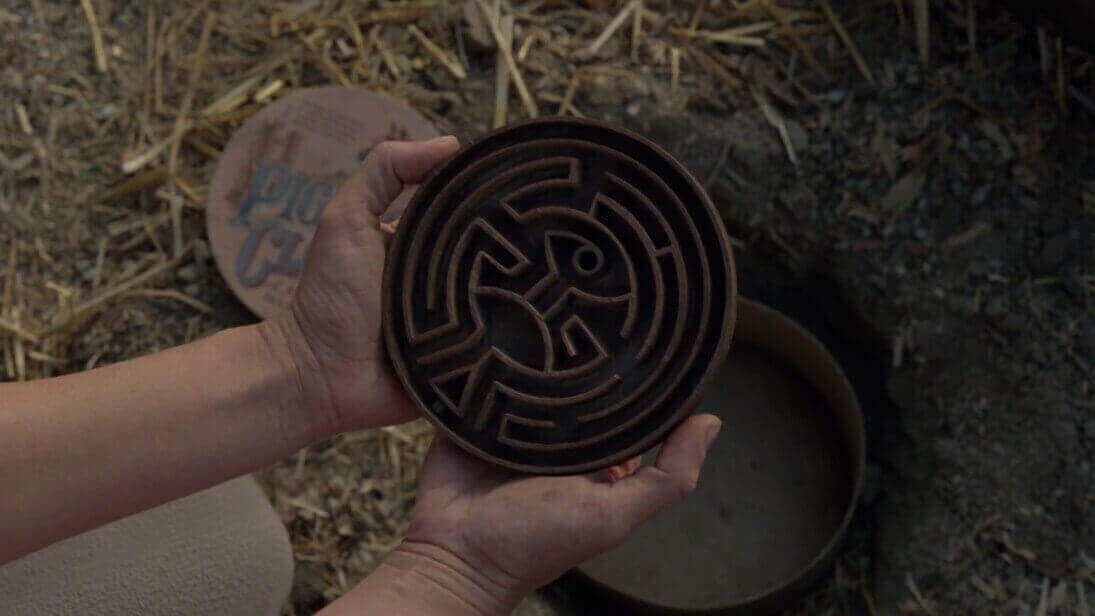
With the emergence of consciousness follows the emergence of God. This is the maze. No other animal creates a divine being in its image and worships it. This is the mirror. Many humans forget about the maze as we continue holding the mirror up to our faces, consoling ourselves with our greatness as gold walls surround us.
Before Greek thought shaped what is now Christianity (especially Catholicism), the Old Testament was grounded in land, lineage, covenant, and national survival. God sent rain or drought, blessings or military defeat. Isaiah 45:7 “I form the light, and create darkness: I make peace, and create evil: I the Lord do all these things.” Within strict sovereign boundaries, God permitted Satan (which was a court position) to test human righteousness and faithfulness, most famously depicted in the Book of Job.
There was no beautiful Heaven that siphoned virtuous and faithful souls, nor was there a fiery Hell to which sinful souls were condemned for eternity. There was only Sheol, a neutral, shadowy underworld that didn’t discriminate between the righteous and the wicked. The only rewards and justice that mattered were those on Earth, and the ultimate reward for following God’s laws was a long life, many children, fertile land, and safety from enemies for the community.
The concept of an immortal soul trapped in a physical body? Plato. Original sin? St. Augustine. In a massive, crowded Roman city during the Pax Romana era, you were an individual surrounded by strangers, disease, extreme wealth inequality, and brutal imperial power. When humans are displaced into dense urban environments with isolating social classes, the psychological need shifts from “How do we manage our land and tribe?” to “How do I find meaning and escape this awful meat-grinder of a world?”
You can see where it all went from there.
To Be or Not to Be God
Theoretical physicist Michio Kaku believes that “by 2100, our destiny is to become like the gods we once worshipped and feared. But our tools will not be magic wands and potions but the science of computers, nanotechnology, artificial intelligence, biotechnology, and most of all, the quantum theory.”
I’m not sure about the timeline or the optimism, but the more we “play God” (i.e., expanding our knowledge of reality and manipulating it with tools forged from the very nature we observe), the clearer it becomes that God is less a transcendent judge and more a divine idealization of ourselves—the sum of our collective desire for order, beauty, and goodness, for truth and moral clarity. Yet God reflects back to us our own humanity, flaws and all, upholding prosocial values while declaring war on difference. The ultimate mirror.
Isn’t it hubristic to want to become God? What is hubris, really, but a primitive defense mechanism? Hubris stops us from going too far. It warns us against embodying an archetype of power and control before we’re intellectually and psychologically integrated. As it should, for more power and control than we can handle maturely and ethically leads to destruction.
Yet, despite the visceral warnings of hubris, I see a connection between what Apocalyptic Jews (the original Christians) believed and the possibilities of science and technology. Influenced by Zoroastrianism, Apocalyptic Jews believed that sometime after the dreamless slumber of death, they would wake up in new physical bodies in a renewed creation. This was the pre-cursor to the ethereal Heaven with cute cherubs smiling down at you. Personally, I prefer a “renewed creation” as opposed to the idea of physical life being naturally corrupt and irredeemable.
“Never again will there be in it an infant who lives but a few days, or an old man who does not live out his years; the one who dies at a hundred will be thought a mere child; the one who fails to reach a hundred will be considered accursed.”
— Isaiah 65:20
However, as the old saying goes, “God helps those who help themselves.” Creation cannot be renewed without our intervention. God is the supreme agency and understanding we subconsciously long for, yet such heights cannot be reached if we continue choosing to be cowards, making excuses for our ignorance and refusing to take responsibility as intelligent, creative beings.
Thus I’ve come to fully understand why Quakerism calls to me.
In traditional dogma, light is the hero that banishes the villainous dark. But in unprogrammed silence, light is a tool for discernment. It doesn’t promise an escape from the meat-grinder, nor does it offer a magical paradise in the clouds. Instead, it asks us to turn inward, sit quietly with the noise of our over-evolved brains, and face the full spectrum that makes up what we are. We are conceptualizing animals, fated to wander the maze, building walls of gold and manufacturing gods out of creed, capital, and code to soothe our existential ache.
But perhaps “ongoing revelation” means realizing that the revelation was us all along. Regardless of whether there is a cosmic force orchestrating a grand plan to save us, the work of divinity—order, beauty, and goodness, as well as truth and moral clarity—rests in human hands, so far the only hands that have proven to be capable of manifesting it.